
Free driving theory mock test
50 questions from all topics. Choose your answers, change them if you like, then press “Finish and mark” to see your score, the answers and an explanation for each question. The real test gives you 57 minutes for 50 questions.
Our own questions, written from The Highway Code to help you study. They are not official DVSA revision questions and are not used in the real test. Independent study site, not affiliated with the DVSA, the Department for Transport or GOV.UK.
Choose an answer for every question, then press “Finish and mark”. Pass mark: 43 out of 50.
Question 1Why is it dangerous to drive with a low brake fluid level?
Show answer
Answer: B – The brakes could fail
Low brake fluid may result in brake failure and a crash. Check fluid levels at least weekly and learn what your low fluid warning light looks like.
Source: Annex 6
Question 2You're passing a horse rider. How much space should you leave between your car and the horse?
Show answer
Answer: C – At least 2 metres
When it's safe to pass, go wide and slow and leave at least 2 metres of space. If you can't give that much room, wait behind the horse.
Source: Rule 215, Rule 163
Question 3You pass a 'Fog' warning sign, but the road ahead looks clear. What should you expect?
Show answer
Answer: D – Patches of thick fog ahead
Even if the road looks clear, there may be a bank of fog or drifting patchy fog ahead. Be ready to slow down, as you can suddenly find yourself in thick fog.
Source: Rule 234
Question 4You're waiting behind the barrier after a motorway breakdown, and it starts to rain heavily. What should you do?
Show answer
Answer: D – Stay where you are, away from the car
Don't go back to your vehicle, even if it's raining, cold or dark. A car stopped on the hard shoulder can be hit by passing traffic, so you're safer behind the barrier.
Source: Rule 277
Question 5You're parking at the roadside next to a car showing a Blue Badge. What should you do?
Show answer
Answer: D – Leave plenty of room beside it
The Blue Badge holder may need extra room to get in or out, perhaps with a wheelchair. Don't stop too close to their vehicle.
Source: Rule 239
Question 6When may you overtake on the left on a normal two-way road?
Show answer
Answer: D – When the vehicle ahead is turning right
Only overtake on the left if the vehicle in front is signalling to turn right and there's room to do so safely. In slow queues you may also pass a slower queue on your right.
Source: Rule 163
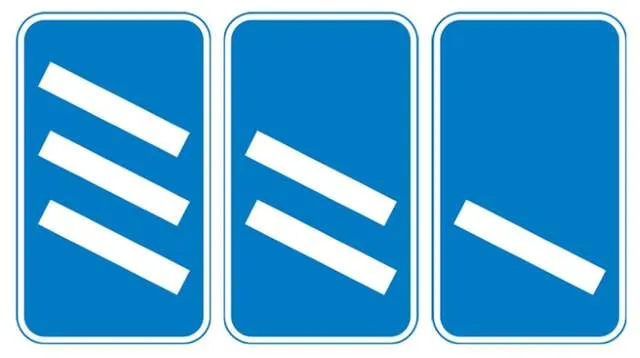
Question 7You're on a motorway and pass the first of these signs. How far are you from the start of the exit slip road?
Show answer
Answer: C – 300 yards
Each bar on a motorway countdown marker stands for 100 yards, so three bars means 300 yards to the exit. Be in the left lane by then.
Source: Traffic signs
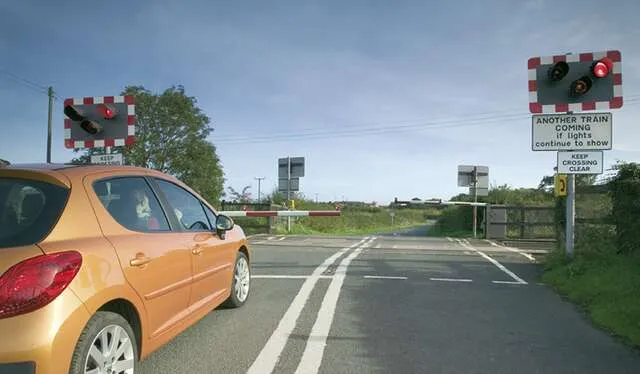
Question 8You're approaching this level crossing and the red lights start to flash. What must you do?
Show answer
Answer: C – Stop behind the white line
You must always obey flashing red stop lights and stop behind the white line. A train can arrive very quickly after they start.
Source: Rule 293
Question 9Why must your car's exhaust system be kept in good condition?
Show answer
Answer: A – Exhaust emissions must stay within legal limits
Exhaust emissions must not exceed the prescribed levels. A damaged exhaust can also be noisy and let harmful fumes into the car.
Source: Annex 6
Question 10You've slowed down because of a flashing amber motorway signal. When may you speed up again?
Show answer
Answer: A – After a signal that isn't flashing
Only increase speed after passing a signal that isn't flashing, or a sign showing END or the national speed limit, and when you're sure it's safe. The hazard may still be ahead.
Source: Rule 257
Question 11You've recently passed your test. A driver beside you at the lights revs their engine as if to race. What should you do?
Show answer
Answer: D – Ignore them and drive at a safe speed
Never show off or compete with other drivers, especially if they're driving badly. Let them go and concentrate on your own safe driving.
Source: Annex 8
Question 12In good daylight, from what distance must you be able to read a modern number plate?
Show answer
Answer: C – 20 metres
You must be able to read a number plate from 20 metres in good daylight (20.5 metres for an old-style plate). If you can't, your eyesight isn't good enough to drive.
Source: Rule 92
Question 13You call 999 after a crash on a dual carriageway. Which detail will help the emergency services most?
Show answer
Answer: A – The exact location and direction of traffic
Responders need to find the incident quickly. Give the exact location, including the direction (for example northbound), the number of vehicles and the condition of any casualties.
Source: Annex 7, Rule 283
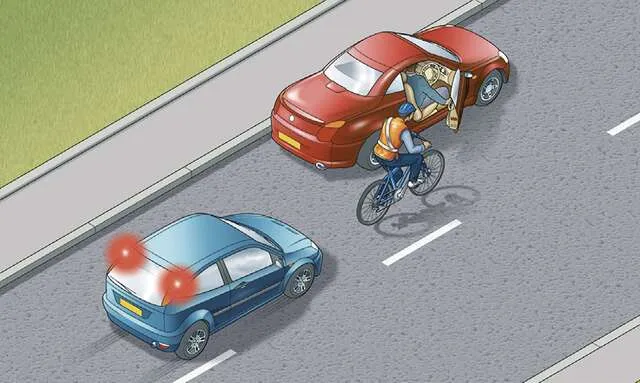
Question 14You're driving the blue car behind this cyclist. A door is opening on the parked car ahead. What should you expect?
Show answer
Answer: A – The cyclist may swerve out in front of you
A door opening in front of a cyclist may force them to swerve into the road. Hang back and leave plenty of room so you can react if they move out suddenly.
Source: Rule 239, Rule 213
Question 15What shape are most direction and information signs?
Show answer
Answer: B – Rectangular
Direction signs are mostly rectangular and information signs are all rectangular. They give information rather than orders or warnings.
Source: Traffic signs
Question 16Which of these items is in the Highway Code's winter emergency kit?
Show answer
Answer: C – A shovel
For an essential journey in snow or ice, take a kit including a shovel, de-icer and scraper, torch, warm clothes and boots, a first aid kit, jump leads, a warm drink and food.
Source: Rule 228
Question 17Why are young children especially at risk near traffic?
Show answer
Answer: B – They may not be able to judge your speed
Children may not be able to judge how fast you're going and could step into the road in front of you. Drive at a speed that lets you stop if they do.
Source: Rule 207, Rule 205
Question 18You're having an argument with a passenger while driving. Why is this dangerous?
Show answer
Answer: A – It distracts you from the road
Arguing with passengers is a distraction that takes your concentration away from driving. Stop somewhere safe if you need to sort things out.
Source: Rule 148
Question 19You're waiting at a red traffic light when an ambulance with flashing blue lights comes up behind. What should you do?
Show answer
Answer: B – Stay put unless you can move safely and legally
Help emergency vehicles get past while still obeying all traffic signs. Don't cross a red light or mount the kerb; the driver will find a way through.
Source: Rule 219
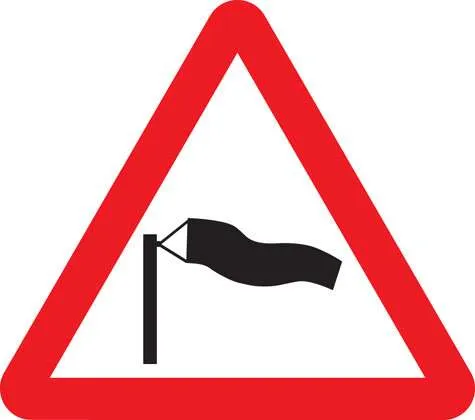
Question 20You see this side winds sign on an exposed road. What should you be ready for?
Show answer
Answer: B – Your car being blown off course
The sign warns that strong crosswinds are likely. Hold the wheel firmly, keep your speed down and give extra room to cyclists, motorcyclists and high-sided vehicles.
Source: Rule 232, Traffic signs
Question 21Why should you avoid starting a long journey between midnight and 6 am?
Show answer
Answer: A – Your natural alertness is at its lowest
Your body is at its least alert in the early hours, which greatly raises the risk of falling asleep at the wheel. Plan long journeys for other times if you can.
Source: Rule 91
Question 22Why should you put on gloves from your first aid kit before you help a bleeding casualty?
Show answer
Answer: C – To protect yourself from their blood
Gloves protect you from contact with the casualty's blood. Put them on when you deal with danger at the scene, if you have them.
Source: Annex 7
Question 23You're driving downhill on a single-track road. A vehicle is coming up the hill towards you. Who should give way?
Show answer
Answer: B – You, if you can
Give way to road users coming uphill whenever you can. Moving off again on a steep slope is harder for them, so let them keep going.
Source: Rule 155
Question 24What's the minimum type of motor insurance you need by law to drive on the road?
Show answer
Answer: C – Third party
Third party cover is the legal minimum. It pays for injury to other people and damage to their property, but not for damage to your own car.
Source: Annex 3
Question 25You're behind a lorry on the motorway. Why might it not go faster than 56 mph?
Show answer
Answer: B – It may have a speed limiter fitted
Many large vehicles have speed limiters that restrict them to 56 mph, even on a motorway. Be patient and plan ahead when you are behind one.
Source: Rule 222
Question 26You see this sign on an exposed road. Which vehicles are most affected by the hazard it warns of?
Show answer
Answer: D – High-sided vehicles
This sign warns of side winds. High-sided vehicles are most affected, but gusts can also push cars, cyclists and motorcyclists off course, especially past gaps in hedges and on bridges.
Source: Rule 232, Traffic signs
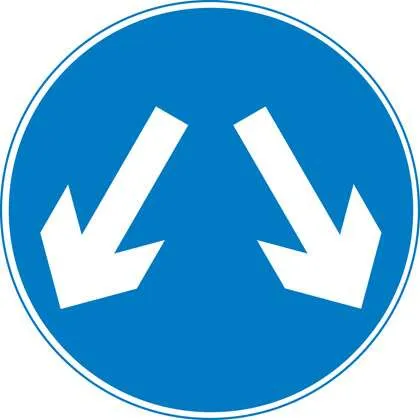
Question 27What does this sign mean?
Show answer
Answer: D – Vehicles may pass either side
Two arrows pointing down to the left and right in a blue circle mean you may pass on either side of the island or obstruction. Both ways lead to the same place.
Source: Traffic signs
Question 28On a motorway, on which side should you normally overtake?
Show answer
Answer: A – On the right
Overtake only on the right. Don't move into a lane on your left to get past someone, and don't weave between lanes.
Source: Rule 267, Rule 268
Question 29How much greater can your stopping distance be on an icy road than on a dry one?
Show answer
Answer: D – Up to ten times greater
On ice your tyres have almost no grip, so stopping distances can be up to ten times those on a dry road. Keep well back and do everything gently.
Source: Rule 126, Rule 230
Question 30A casualty has a burn. For how long should you cool it with clean, cool water?
Show answer
Answer: A – At least 20 minutes
Cool the burn with plenty of clean, cool water for at least 20 minutes. This takes heat out of the skin and reduces pain and damage. Put out any flames first, taking care for your own safety.
Source: Annex 7
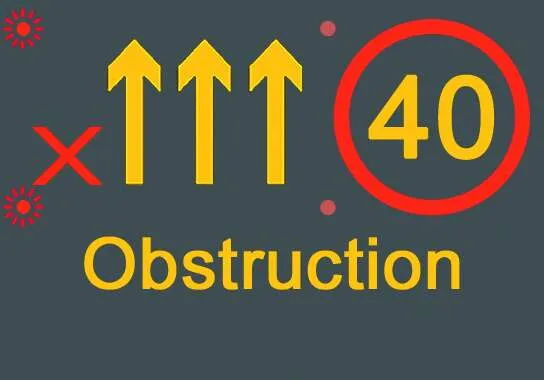
Question 31You're on a motorway and see this sign. What does it mean?
Show answer
Answer: D – Left lane closed; 40 mph is a mandatory limit
The red X means you MUST NOT enter or stay in the left lane. A speed in a red ring is a temporary mandatory limit, and the message tells you why.
Source: Light signals controlling traffic, Rule 258
Question 32The lights at a crossing change to green while a pedestrian is still crossing. What should you do?
Show answer
Answer: A – Wait for them to finish crossing
Give way to anyone still crossing after the signal for vehicles has changed to green. This applies at all crossings; some people need longer to get across.
Source: Rule 198
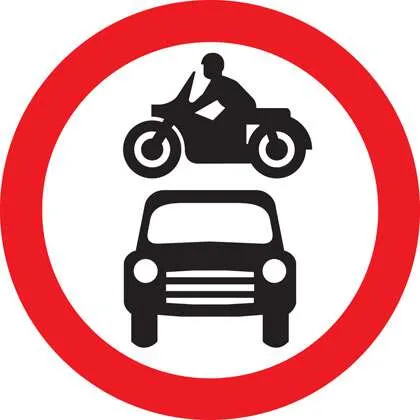
Question 33What does this sign mean?
Show answer
Answer: C – No motor vehicles
A motorcycle above a car in a red circle means no motor vehicles may go past the sign. Don't confuse it with 'No overtaking', which shows two cars side by side.
Source: Traffic signs
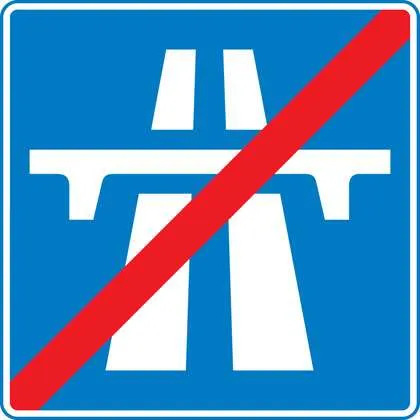
Question 34What does this sign mean?
Show answer
Answer: A – End of motorway
The motorway symbol crossed by a red diagonal bar marks the end of the motorway. Motorway regulations stop here, so check for the speed limit on the road ahead.
Source: Traffic signs
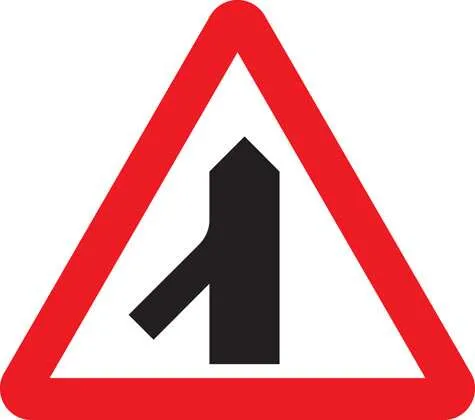
Question 35What does this sign mean?
Show answer
Answer: A – Traffic merging from left ahead
The broader line is the priority through route and the thinner line joins it from the left. Be ready for traffic merging into your path.
Source: Traffic signs
Question 36You're towing a caravan on a motorway with three lanes. Which lane mustn't you use?
Show answer
Answer: B – The right-hand lane
A vehicle towing a trailer mustn't use the right-hand lane of a motorway with three or more lanes, except in prescribed circumstances. Keep to the left and middle lanes.
Source: Rule 98, Rule 265
Question 37When may you use hazard warning lights while driving?
Show answer
Answer: D – On a motorway, to warn of a hazard ahead
You mustn't use hazard lights while moving unless you're on a motorway or unrestricted dual carriageway and need to warn drivers behind of a hazard ahead. Use them only briefly.
Source: Rule 116
Question 38You're driving through a town centre at night. Between which times mustn't you sound your horn, unless another road user poses a danger?
Show answer
Answer: B – 11.30 pm and 7 am
In a built-up area you must not use your horn between 11.30 pm and 7 am, except to warn someone of danger. This protects people from noise at night.
Source: Rule 112
Question 39You're behind a cyclist on a narrow road. Oncoming traffic means you can't leave enough room to pass. What should you do?
Show answer
Answer: C – Stay behind until you can pass safely
If you can't give a cyclist the recommended space, wait behind them and don't overtake. A short delay is better than putting a vulnerable road user at risk.
Source: Rule 163
Question 40Why should you avoid parking very close to a car showing a Blue Badge?
Show answer
Answer: A – The occupant may need room to get out
A Blue Badge shows that the car is used by a disabled person. They may need extra space beside it to get in or out, so don't park too close.
Source: Rule 239
Question 41You fitted a roof box for a holiday and no longer need it. What should you do with it?
Show answer
Answer: A – Take it off to cut drag and save fuel
A roof box adds wind resistance and makes the car use more fuel, even when it is empty. Remove it when you are not using it.
Source: Driving – the essential skills
Question 42You've just driven through a deep ford. What should you do first?
Show answer
Answer: A – Test your brakes
Water can make your brakes much less effective. Test them at the first safe opportunity by pressing the brake pedal gently.
Source: Rule 121
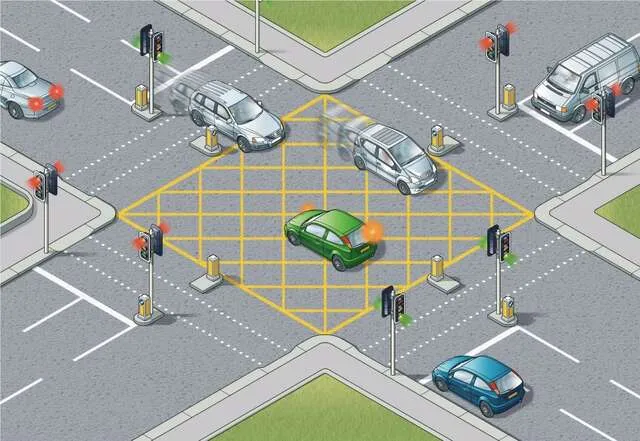
Question 43You're waiting at traffic lights at a box junction like this. When may you enter the yellow box?
Show answer
Answer: A – When your exit road is clear
You mustn't enter a box junction until your exit road or lane is clear. Stopping in the box would block traffic crossing from other directions.
Source: Rule 174
Question 44You're driving in town and a bus ahead signals to pull away from a stop. What should you do?
Show answer
Answer: B – Give way to it if it's safe
Give priority to buses pulling away from stops whenever you can do so safely. It helps traffic flow and avoids a conflict as the bus moves out.
Source: Rule 223
Question 45You're driving on a country road through farmland. What hazards should you be prepared for?
Show answer
Answer: C – Mud and slow farm vehicles
Country roads may have slow-moving farm vehicles, mud on the surface, horse riders and pedestrians. Keep your speed down so you can stop in the distance you can see.
Source: Rule 154
Question 46Spray from a lorry ahead is making it hard to see on a wet motorway. What should you do?
Show answer
Answer: D – Drop back until you can see better
Rain and spray make it hard to see and be seen. Keeping well back gives you a better view, more time to react and room for the longer stopping distances in the wet.
Source: Rule 227, Rule 222
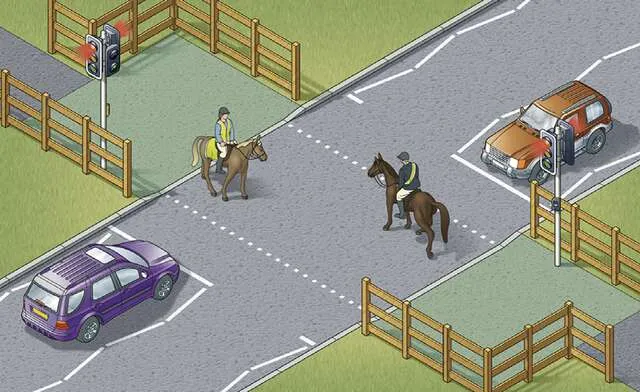
Question 47You're approaching this crossing, which has a high control panel and wide crossing spaces. Who is it mainly for?
Show answer
Answer: C – Horse riders
Equestrian crossings have higher controls, wider spaces and horse and rider figures in the lights. Be patient and avoid revving your engine near horses.
Source: Rule 27, Rule 199
Question 48You're about to turn right at a junction. In which order should you carry out the routine for changing direction?
Show answer
Answer: B – Mirrors, signal, manoeuvre
Check your mirrors first so you know what's behind and beside you, then signal your intention, then make the manoeuvre. Signalling before looking could mislead someone you haven't seen.
Source: Rule 161, Rule 180
Question 49Where mustn't you fit a rear-facing baby seat?
Show answer
Answer: D – In a seat with an active frontal airbag
If an active frontal airbag goes off, it can hit a rear-facing baby seat and seriously injure or kill the baby. Never fit one in a seat protected by an active airbag.
Source: Rule 101
Question 50You're on a roundabout behind a cyclist who is in your lane. What should you do?
Show answer
Answer: A – Stay behind them and give them plenty of room
Give priority to cyclists on a roundabout. They travel more slowly than cars, so give them plenty of room, don't try to overtake them in their lane and let them move across your path.
Source: Rule 186
Pictures: The Highway Code, © Crown copyright, used under the Open Government Licence v3.0.

Our app is coming soon
Theory Prep has 750 practice questions in all 14 theory test topics,15 mock tests of 50 questions with a 57-minute timer, practice for your weak questions and The Highway Code built in.